
 English
 русский
 Español
 Indonesia
 Tiếng Việt
 Current Location: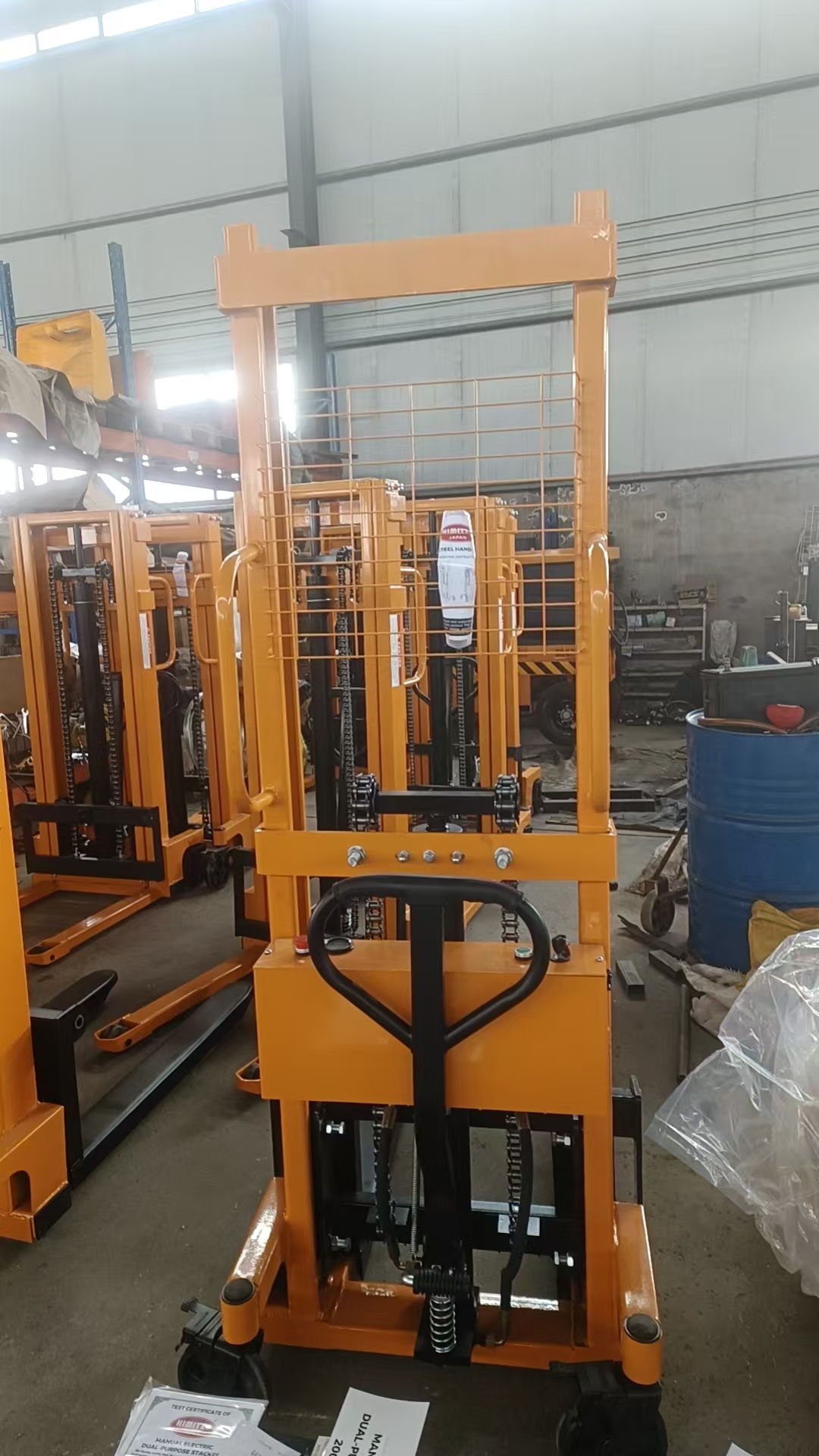

Online consulting
If you have any questions, please contact our online customer service staff immediately
Electric & Manual Dual-Mode Stacker
 Click:8
  Time:2026-04-14 16:00:18
Electric & Manual Dual-Mode Stacker
Working Principle and Key Components Explained (By mkbkhoist Engineers)
In modern warehouses, efficiency is no longer just about speed—it’s about control, flexibility, and reliability.
At mkbkhoist, we’ve seen a growing demand for one particular solution: electric and manual dual-use stackers.
Why? Because real working conditions are rarely ideal. Power interruptions happen. Budgets are limited. Operators need flexibility.
Instead of choosing between manual or electric, engineers developed a system that combines both.
This article explains how it works from a practical engineering perspective.
1. What Is a Dual-Mode Stacker?
A dual-mode stacker integrates:
- Electric lifting and driving system
- Manual hydraulic backup system
It bridges the gap between fully electric stackers and manual stackers.
In practical terms, it means:
When power is available, efficiency is high.
When power is unavailable, operation can continue manually.
This makes it especially suitable for markets and environments where stability and cost control are both critical.
2. Core Working Principle
The lifting mechanism follows a straightforward energy conversion process:
Human force or battery power is converted into hydraulic pressure, which then drives mechanical lifting.
Working sequence:
-
Power input
Electric mode uses battery-driven motor
Manual mode uses handle pumping -
Hydraulic activation
The pump pressurizes hydraulic oil
Oil flows through control valves -
Cylinder movement
Hydraulic cylinder extends
Chains and mast guide vertical motion -
Load lifting
Forks rise along the mast
Load is lifted and stabilized -
Lowering
Pressure is released via valve
Oil returns to tank
Forks descend smoothly under gravity
This combination of hydraulic and mechanical systems ensures stable and controlled lifting performance.
3. Key Components Breakdown
3.1 Dual Power System
This is the defining feature of the machine.
Main elements include:
- Battery (lead-acid or lithium)
- Electric motor
- Manual hydraulic pump
The system provides redundancy. Even if the battery is depleted, the machine remains usable.
3.2 Hydraulic System
The hydraulic system is responsible for lifting force generation.
Components include:
- Hydraulic pump
- Oil cylinder
- Control valves
- Oil reservoir
Hydraulics are used because they provide smooth motion, high load capacity, and precise control.
3.3 Mast Structure
The mast acts as the structural backbone.
- High-strength steel construction
- Available in multiple stages (single, duplex, triplex)
- Chain and pulley transmission
It ensures vertical alignment and load stability during lifting.
3.4 Fork Assembly
The forks directly handle the load.
- Reinforced steel forks
- Optional adjustable width
Their design affects load balance, safety, and compatibility with different pallets.
3.5 Control System
The control system connects the operator to the machine.
- Control handle (tiller)
- Lift and lower controls
- Speed regulation
- Emergency stop
It regulates hydraulic flow and machine movement for safe operation.
3.6 Drive System
Responsible for mobility.
- Electric drive motor
- Steering system
- Load wheels
In electric mode, movement is powered. In manual mode, the unit can still be pushed and positioned.
4. Why Dual-Mode Matters
From an engineering and operational perspective, dual-mode design solves real problems.
Power interruption
Fully electric machines stop working
Dual-mode machines continue manually
Cost control
Electric forklifts require higher investment
Dual-mode stackers offer a balanced solution
Flexible usage
Light tasks can be handled manually
Heavy lifting can switch to electric
One machine adapts to multiple working conditions.
5. Typical Applications
Based on field experience, dual-mode stackers are widely used in:
- Small and medium warehouses
- Manufacturing workshops
- Retail storage environments
- Logistics transfer stations
They are particularly suitable where space is limited, budgets are controlled, and reliability is essential.
6. Engineer’s Perspective
A well-designed machine is not defined by maximum power, but by consistent performance under real conditions.
Dual-mode stackers are designed to keep working, even when conditions are not ideal.
At mkbkhoist, the focus is on practical usability, long-term reliability, and adaptability in real-world environments.
#ElectricStacker #ManualStacker #DualModeStacker #SemiElectricStacker #PalletStacker #HydraulicStacker #MaterialHandling #WarehouseEquipment #LogisticsEquipment #IndustrialEquipment #StackerTruck #PalletHandling #WarehouseSolutions #LiftingEquipment #ForkliftAlternative #CompactStacker #FactoryEquipment #SupplyChain #OEMManufacturer #mkbkhoist
- Previous Article:
- Next Article: Lifting Sling Manufacturing and Quality Control

 Factory Address: Dongl ü industrial Area,Qingyuan District, Baoding City, Hebei Province, China
 Contact number:
 Emall:
  Website:



 Home
Home Whatsapp
 Email
Email
