
 English
 русский
 Español
 Indonesia
 Tiếng Việt

 Current Location:
-
Stand-On Electric Reach Truck: Make Better Use of Your Warehouse Space | MKBK Hoist
-
Cargo Trolley and Moving Skates 4–60T: Heavy-Duty Material Handling Equipment Ready for Shipment | MKBK Hoist
-
Customized Three-Way Stacker: A Smart Solution for Narrow-Aisle Warehousing | MKBK Hoist
-
MKBK Hoist 2026 China National Day Holiday Notice | October 1–7

Online consulting
If you have any questions, please contact our online customer service staff immediately
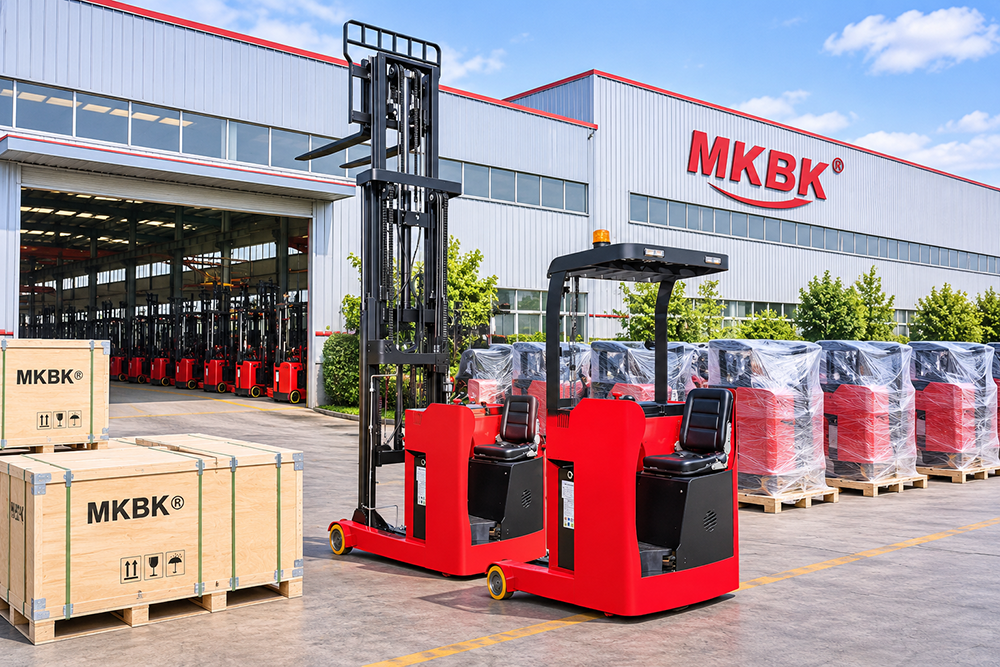
Stand-On Electric Reach Truck: Make Better Use of Your Warehouse Space | MKBK Hoist
 Click:4
 Time:2026-11-04 16:50:24
A bigger warehouse isn't always the answer. Sometimes, the right forklift can give you more space without adding a single square meter.
Warehouse space is expensive. Whether you're running a distribution center, a manufacturing plant, or a growing logistics business, every square meter matters.
But here's a question worth asking: Are you really using all the space you already have?
In many warehouses, wide aisles take up valuable floor space, while the upper levels of storage racks remain underused. Expanding the building may seem like the obvious solution, but it also means higher rent, construction costs, and additional operating expenses.
A stand-on electric reach truck offers another approach.
Designed for narrow-aisle operation and high-level pallet handling, this type of electric forklift helps warehouses make better use of vertical storage space while maintaining efficient material movement.
At MKBK Hoist, we believe choosing the right material handling equipment should start with understanding the warehouse, not simply comparing forklift prices.
What Is a Stand-On Electric Reach Truck?
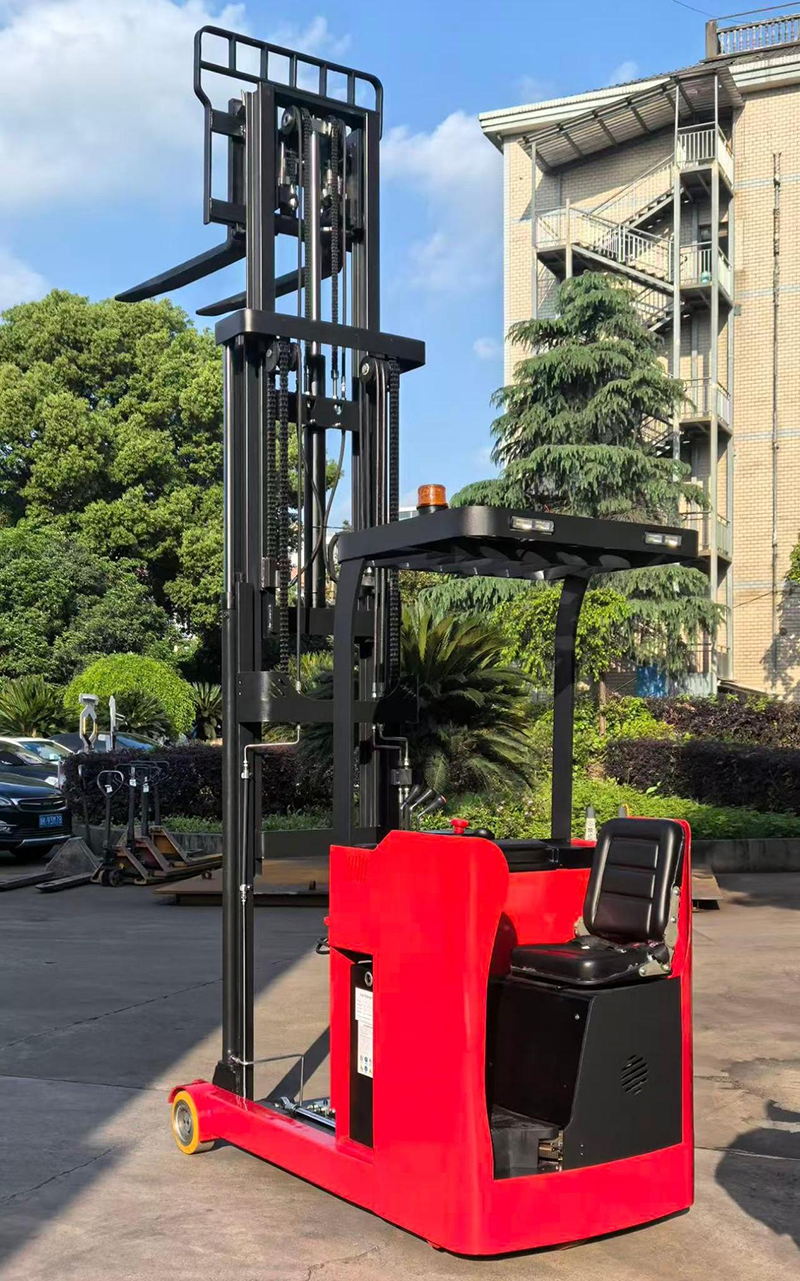
A stand-on electric reach truck is a battery-powered industrial truck designed primarily for handling palletized loads in warehouse racking systems.
Unlike a conventional counterbalance forklift, a reach truck uses a specialized lifting and reaching mechanism to position loads within storage racks. Depending on the design, the forks or mast assembly can extend forward to pick up or place pallets and retract for travel.
The operator stands in a dedicated operating compartment, allowing convenient access to the controls and good visibility of the working area.
This design makes the equipment particularly useful in warehouses where space is limited and pallets need to be stored at different heights.
Reach trucks are commonly used in logistics centers, manufacturing warehouses, wholesale distribution facilities, and other indoor storage environments.
Their main advantages are straightforward: narrower working aisles, greater access to vertical storage, and controlled pallet positioning.
However, the actual performance depends on the truck model, rack arrangement, load dimensions, floor conditions, and operating requirements.
1. Narrow-Aisle Operation: More Room for Inventory
One of the biggest advantages of a stand-on reach truck is its ability to work in narrower aisles than many conventional counterbalance forklifts.
In a traditional warehouse, a significant amount of floor space may be reserved for forklift turning and maneuvering. While this is necessary for safe operation, it reduces the area available for storage racks.
A reach truck is designed to handle pallets in a more compact working environment.
Its reaching mechanism allows the operator to position the forks toward the rack while keeping the truck within the aisle. This can reduce the maneuvering space required for suitable storage operations.
From a warehouse planning perspective, even a modest reduction in aisle width can create opportunities for additional rack positions.
But narrower is not always better.
The minimum operating aisle width depends on the reach truck's dimensions, turning characteristics, pallet size, load orientation, and required safety clearances.
An engineer should calculate the necessary working aisle using the specific truck and pallet configuration rather than relying on a general industry figure.
The goal is to increase storage density without making daily operations difficult or unsafe.
2. High Lifting Capability: Use the Space Above You
Many warehouses have unused vertical space.
The building may already have sufficient ceiling height for additional rack levels, but the existing handling equipment cannot reach them efficiently.
A stand-on electric reach truck is designed for high-level pallet storage, making it possible to access elevated rack positions within the machine's rated operating limits.
This can help warehouses increase storage capacity without immediately expanding the building footprint.
However, selecting a reach truck based only on maximum lifting height is a common mistake.
From an engineering perspective, three questions matter:
How high must the pallet actually be lifted? How much does the load weigh at that height? And how much clearance is available between the raised load, racking, and building structure?
The rated lifting capacity of a reach truck may decrease as lifting height increases or as the load center changes.
A truck capable of handling a particular weight at a low height may have a lower permitted capacity at maximum lift.
For this reason, buyers should always review the manufacturer's load capacity chart for the specific configuration.
High lifting performance is valuable only when it matches the actual pallet weight and storage height.
3. Flexible Operation: Designed for Busy Warehouses
A warehouse rarely operates under perfect conditions.
Operators need to collect pallets, turn into aisles, position loads, and move between storage and loading areas throughout the working day.
A stand-on reach truck is designed to support these repetitive handling tasks in suitable indoor environments.
Its compact layout and electric drive system can make it convenient for frequent pallet movement and precise positioning.
The standing operator arrangement can also be useful in applications where operators regularly enter and leave the truck, depending on the model and working procedure.
Electric controls allow the operator to manage travel, lifting, lowering, and reaching functions according to the truck's design.
Some configurations may include additional features that support visibility, control, or operator comfort.
Still, maneuverability should not be confused with unlimited operating capability.
Reach trucks are generally intended for suitable warehouse floors. Uneven outdoor surfaces, steep gradients, and unsuitable loading areas may require a different type of forklift.
Choosing the right truck means understanding where it will work every day.
4. An Engineer's View: Four Specifications Buyers Should Check
A reach truck may look impressive in a product video, but the real question is whether it will perform well in your warehouse.
Lifting height and residual capacity
The first step is to confirm the maximum rack height and the weight of the heaviest pallet stored at that level.
The truck's residual capacity at the required height must be sufficient for the intended load. Buyers should never assume that the nominal rated capacity applies at every lifting height.
Aisle width and turning space
The required aisle width should be calculated using the selected reach truck model, pallet dimensions, load orientation, and safe operating clearances.
The warehouse layout should also account for intersections, turning areas, and the space required to approach racks.
Battery and operating schedule
Battery selection affects how the equipment fits into daily operations.
The appropriate battery capacity and charging arrangement depend on working hours, travel distance, lifting frequency, load weight, and operating intensity.
A warehouse operating one shift may have different requirements from a facility running multiple shifts.
Floor and rack conditions
High-level pallet handling requires suitable operating conditions.
Floor flatness, load-bearing capacity, rack dimensions, and pallet quality all affect safe and efficient operation.
A reach truck should not be selected independently of the warehouse environment in which it will work.
These details are often more important than choosing a machine simply because it has the highest advertised lifting height.
5. How Can a Reach Truck Help Reduce Warehouse Operating Costs?
Warehouse operating costs come from several sources: building space, labor, equipment, energy, maintenance, and inventory movement.
A stand-on electric reach truck can influence these costs in different ways.
First, better use of vertical storage and narrower aisles may increase the number of pallet positions available within an existing warehouse.
Second, equipment suited to the warehouse layout can reduce unnecessary maneuvering and make pallet handling more efficient.
Third, electric operation avoids direct exhaust emissions at the point of use, which is beneficial for many indoor warehouse environments. Battery charging, ventilation, and maintenance requirements must still be considered according to the battery type.
Finally, choosing the correct equipment can help avoid the expense of purchasing a forklift that is too large, too small, or unsuitable for the application.
Of course, cost savings are not automatic.
A reach truck may require investment in suitable racking, floor preparation, operator training, and charging facilities.
The best way to evaluate its economic benefit is to compare the complete warehouse operation before and after the proposed equipment change.
6. Reach Truck or Counterbalance Forklift: Which Is Better?
There is no single forklift that is best for every warehouse.
A conventional counterbalance forklift can be a practical choice for general loading, unloading, and mixed indoor or outdoor handling, depending on the model.
A stand-on electric reach truck is particularly useful for suitable indoor warehouses with pallet racking, narrower aisles, and higher storage requirements.
If your main challenge is moving pallets across a yard or loading trucks on uneven surfaces, a counterbalance forklift may be more appropriate.
If your main challenge is limited warehouse space and underused high-level racks, a reach truck may offer greater value.
The decision should be based on the working environment, load requirements, warehouse layout, and daily handling frequency.
Buying the right forklift is not about choosing the most powerful machine. It is about choosing the machine that makes your warehouse work better.
7. Factory-Direct Reach Truck Solutions from MKBK Hoist
Every warehouse has different requirements.
Some customers need a compact machine for narrow aisles. Others are more concerned about lifting height, pallet weight, battery configuration, or operator convenience.
MKBK Hoist supplies material handling equipment and works with customers to identify suitable configurations based on their applications.
When discussing a stand-on electric reach truck, we recommend confirming the pallet dimensions, maximum load weight, required lifting height, aisle width, working hours, and power requirements before selecting a model.
Where special configurations are needed, technical feasibility should be reviewed before the order is finalized.
Factory-direct communication helps customers clarify specifications and understand which equipment features are relevant to their warehouse operations.
Our focus is on practical material handling solutions that fit real working conditions.
8. What Should You Tell Us Before Requesting a Quotation?
If you're planning to purchase a stand-on electric reach truck, start with a few important details.
Tell us the maximum pallet weight, required lifting height, pallet dimensions, and available aisle width.
It is also helpful to know how many hours the truck will operate each day, whether the warehouse has multiple shifts, and whether you have any battery preferences.
If possible, share a warehouse layout drawing or photos of your racking system.
These details help us understand your requirements and discuss a more suitable reach truck configuration.
A clear specification at the beginning can save time, reduce unnecessary changes, and make purchasing decisions easier.
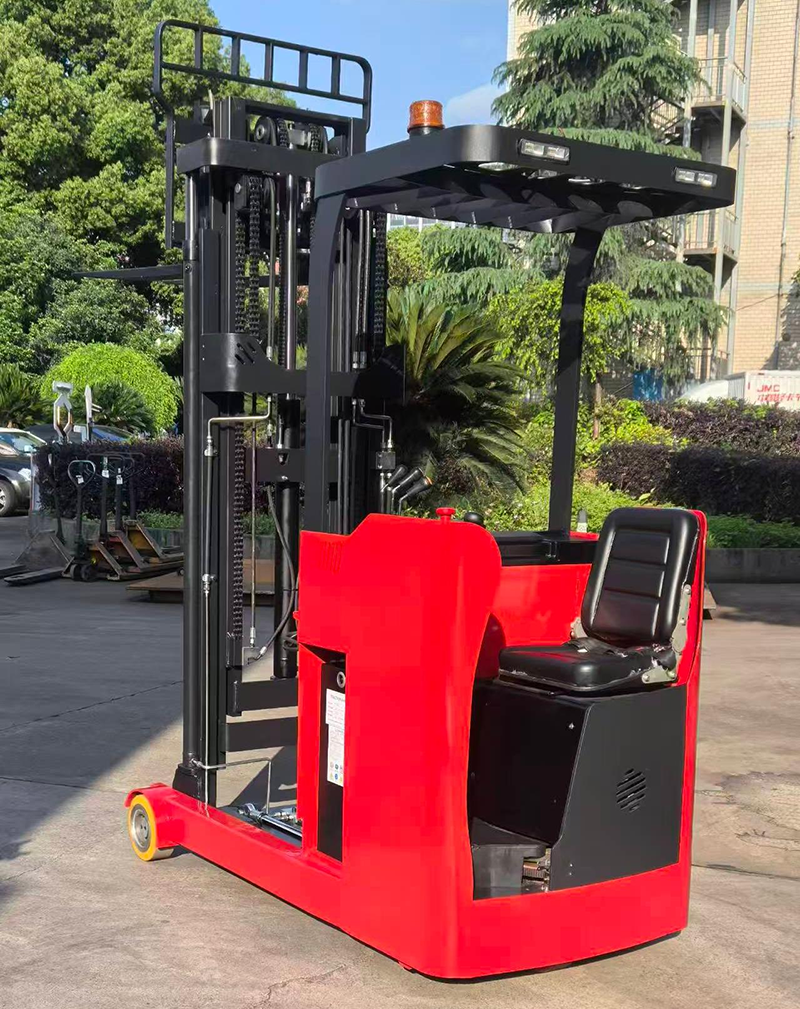
Make Every Square Meter Work Harder
Warehouse efficiency is not simply about moving pallets faster.
It is about using available space intelligently, reducing unnecessary movement, and choosing equipment that supports the entire storage process.
A stand-on electric reach truck can help achieve these goals by combining narrow-aisle maneuverability, high-level pallet handling, and flexible electric operation.
For warehouses facing rising storage costs and growing inventory demands, the right reach truck may provide an opportunity to increase storage density without immediately expanding the building.
Looking for a stand-on electric reach truck for your warehouse?
Send MKBK Hoist your lifting height, pallet weight, and aisle width. Let's discuss a suitable solution for your operation.
- Previous Article:
- Next Article: Cargo Trolley and Moving Skates 4–60T: Heavy-Duty Material Handling Equipment Ready for Shipment | MKBK Hoist

 Factory Address: Dongl ü industrial Area,Qingyuan District, Baoding City, Hebei Province, China
 Contact number:
 Emall:
 Website:





 Home
 Whatsapp
 Email