
 English
 русский
 Español
 Indonesia
 Tiếng Việt

 Current Location:
-
Wireless Remote Control Electric Scaffolding: A Smarter Way to Work at Height | MKBK Hoist
-
Before Shipment: How MKBK Hoist Prepares Pallet Trucks, Stackers and Electric Hoists for Delivery
-
Semi-Electric Stacker with Paper Roll Clamp: Customized Handling Solutions | MKBK Hoist
-
Drum Handling Tools: Making Oil Drum Lifting, Moving and Positioning Easier | MKBK Hoist
Online consulting
If you have any questions, please contact our online customer service staff immediately
Wireless Remote Control Electric Scaffolding: A Smarter Way to Work at Height | MKBK Hoist
 Click:23
 Time:2026-11-25 09:07:54
The real value of a machine is not how much work it can do, but how much unnecessary work it can take away.
Anyone who has worked on a construction or renovation project knows how tiring traditional scaffolding can be. Workers spend time assembling steel frames, climbing up and down, adjusting working heights, and dismantling the structure when the job is finished.
Sometimes, preparing for the work takes almost as much effort as the work itself.
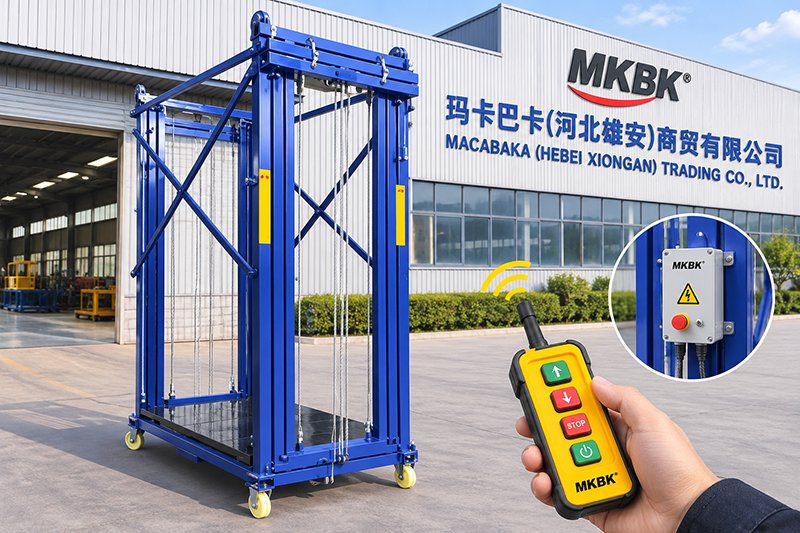
MKBK Hoist wireless remote control electric scaffolding offers a more practical approach. With motor-driven lifting, wireless remote control, and smooth height adjustment, it helps reduce repetitive manual work, improve productivity, and lower labor costs in suitable elevated working applications.

What Is Wireless Remote Control Electric Scaffolding?
Wireless remote control electric scaffolding is a powered lifting platform designed for construction, decoration, installation, and maintenance work at height.
Unlike conventional scaffolding, which often requires manual assembly and adjustment when changing working heights, electric scaffolding uses a motor-driven lifting system to raise and lower the platform.
The operator can control the lifting movement through a wireless remote controller, within the equipment's specified operating conditions.
Once the equipment is correctly assembled and positioned, workers can adjust the platform height without repeatedly dismantling and rebuilding the supporting structure.
This makes electric scaffolding particularly useful for projects that require frequent changes in working height.
MKBK Hoist offers electric scaffolding options with lifting heights ranging from 2 to 20 meters and rated load capacities from 300kg to 500kg across different models. The final capacity and supporting configuration depend on the selected lifting height and equipment design.
Why Wireless Remote Control Makes a Difference
A wireless remote controller may look like a small component, but it can make a noticeable difference to everyday operation.
Traditional height adjustment often requires additional manual work. With electric scaffolding, operators can control lifting and lowering through simple commands, without being restricted by a conventional wired controller.
For jobs such as painting, ceiling installation, electrical maintenance, and wall decoration, workers frequently need to adjust their working position. Powered height adjustment can make these transitions quicker and more convenient.
From an engineering perspective, however, wireless control must be considered together with the complete electrical control system.
Signal reliability, motor response, braking performance, emergency-stop arrangements, and protection against unintended movement are important considerations when evaluating powered lifting equipment.
Wireless operation should improve convenience without compromising control or safe working procedures.
An Engineer's Perspective: What Makes Electric Scaffolding Reliable?
Motor Performance and Lifting Stability
The motor is responsible for providing the power required to raise and lower the platform. Its performance must match the lifting mechanism, platform weight, rated load, and intended operating frequency.
A larger motor does not automatically mean better performance. The relationship between motor output, transmission efficiency, braking capability, and lifting speed is equally important.
Smooth lifting helps reduce sudden movement and unnecessary mechanical stress. It also provides a more comfortable working experience when the equipment is approved for personnel lifting.
Structural Strength and Load Distribution
As lifting height increases, structural stability becomes increasingly important.
The supporting frame must withstand the forces generated by the platform, its load, and normal operating movements. Uneven load distribution can introduce additional stresses that affect stability.
The rated load includes everything carried on the platform, such as workers, tools, and construction materials.
A 500kg capacity does not necessarily apply to every lifting height. Buyers should confirm the approved load rating for the specific model rather than relying only on the maximum capacity advertised for the product range.
Ground Conditions and Supporting Structure
Even well-designed lifting equipment depends on suitable ground conditions.
The operating surface must have sufficient load-bearing capacity and meet the manufacturer's requirements for levelness and stability. Wheel locks, stabilizers, and other supporting components must be used as specified.
For outdoor applications, wind conditions, weather exposure, and surrounding obstacles must also be considered.
Higher lifting height brings greater engineering responsibility. Equipment must never be operated beyond its approved height, load, or environmental limits.
Electric Scaffolding vs. Traditional Scaffolding
Traditional scaffolding remains a practical solution for many construction projects, particularly when a large, fixed working area is required for an extended period.
However, for jobs involving frequent height changes, electric scaffolding can offer several operational advantages.
Powered lifting reduces the need for repeated manual height adjustments. Wireless control simplifies operation, while a suitable platform design allows workers to organize tools and materials more conveniently.
For contractors handling multiple renovation or maintenance projects, reducing setup and adjustment time can help improve equipment utilization and labor productivity.
The financial benefit depends on project duration, workforce size, working conditions, and how frequently the platform height needs to change.
Rather than comparing equipment prices alone, buyers should consider the total cost of completing the job.
A machine that saves working hours on repeated projects may offer greater long-term value than equipment with a lower initial purchase price.
Where Can Electric Scaffolding Be Used?
Wireless remote control electric scaffolding can serve a wide range of applications when the selected model is suitable for the working environment.
In interior decoration, it can assist with ceiling installation, wall painting, lighting installation, and renovation work.
In construction projects, suitable configurations can support elevated finishing, installation, and maintenance tasks.
In factories and warehouses, electric scaffolding can help maintenance teams access overhead equipment, ventilation systems, lighting fixtures, and other elevated facilities.
Equipment installation companies can also benefit from adjustable working heights when positioning components at different levels.
For equipment distributors and rental businesses, electric scaffolding offers another product category for customers looking to reduce manual work and improve job-site productivity.
Factory-Direct Supply and Pre-Shipment Testing
At MKBK Hoist, we understand that overseas buyers need more than attractive product photos and competitive prices. They need equipment that matches their actual requirements.
Before shipment, electric scaffolding is commissioned according to the confirmed configuration and applicable inspection procedures.
Relevant checks may include motor operation, lifting and lowering functions, wireless remote control response, electrical connections, braking performance, and configured safety devices.
The supporting structure and mechanical connections also require attention before packing.
Pre-shipment testing helps identify potential problems before the equipment leaves the factory, reducing avoidable delays during installation and initial operation.
For customized orders, lifting height, rated capacity, platform dimensions, power supply, and operating requirements should be confirmed before production.
Choosing the Right Electric Scaffolding for Your Business
Before purchasing electric scaffolding, consider your required lifting height, maximum total platform load, available working space, power supply, and whether the equipment will operate indoors or outdoors.
Customers planning to lift personnel must also confirm that the specific model is designed and approved for personnel lifting and complies with applicable local safety requirements.
Whether you are a construction contractor, equipment distributor, rental company, or industrial maintenance provider, MKBK Hoist can discuss a suitable configuration based on your actual application.
Still spending valuable working hours assembling and adjusting traditional scaffolding?
Send us your required lifting height, load capacity, and working conditions. Let's find a more efficient solution for your next project.
MKBK Hoist — Less manual work. More productivity. Smarter lifting.
- Previous Article:
- Next Article: Before Shipment: How MKBK Hoist Prepares Pallet Trucks, Stackers and Electric Hoists for Delivery

 Factory Address: Dongl ü industrial Area,Qingyuan District, Baoding City, Hebei Province, China
 Contact number:
 Emall:
 Website:





 Home
 Whatsapp
 Email